

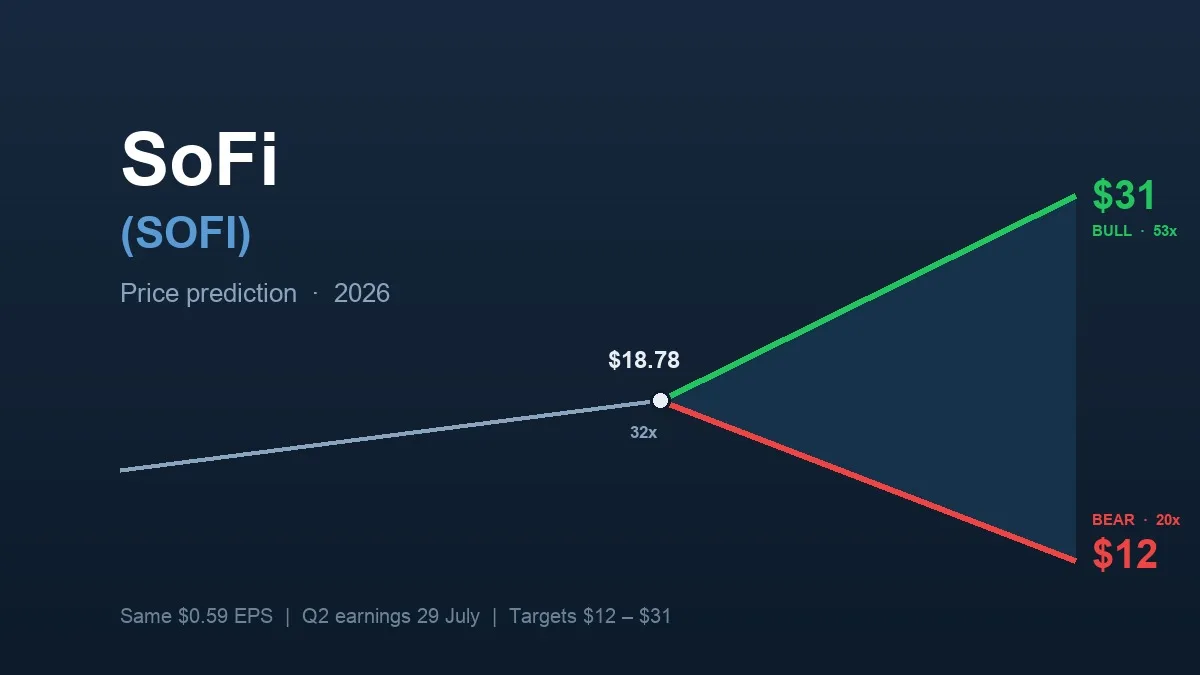
Wall Street is not arguing about how much money SoFi will make this year. That is the single most misunderstood thing about this stock, and once you see it, the entire $12-to-$31 target range stops looking like chaos and starts looking like a single, specific question. Analysts have largely converged on 2026 earnings of about $0.59 per share on revenue of roughly $4.68 billion, per StockAnalysis. Now do the arithmetic on the targets. The $12 bear case is that same $0.59 at roughly 20 times earnings. The $31 bull case is that same $0.59 at roughly 53 times earnings. The current $18.78 share price is that same $0.59 at about 32 times. Nobody is disputing the E. They are fighting over the P/E — and the P/E is really a verdict on whether the E is real.
That is why SoFi (SOFI) is the most interesting fintech chart on the board right now. Traditional lenders trade at single-digit-to-low-teens multiples, because the market treats balance-sheet earnings as low quality and cyclical. Platform fintechs trade at 40x and above, because fee income is capital-light and repeatable. SoFi is legally a bank holding company, supervised by the Federal Reserve and the OCC, and it wants to be valued like a technology platform. At 32x, the market is not siding with either camp — it is pricing a coin flip. And the coin was weighted, in March, by a short-seller who stood up and said the profits are fake.
Key facts
- Share price $18.78 (10 July 2026); consensus target $21.10, high $31, low $12, 24 analysts, “Hold” — StockAnalysis, July 2026
- Q1 2026 net revenue a record $1.1 billion; net income $167M, more than double a year earlier — SoFi, 29 April 2026
- Adjusted EBITDA $340M, up 62% year over year, at a 31% margin — SoFi, April 2026
- Members 14.7 million, up 35%, after a record 1,055,000 additions in the quarter; products up 39% to 22.2 million — SoFi, April 2026
- Yet the stock is down roughly 32% year to date from a $32.73 peak in late 2025 — TIKR, June 2026
- Muddy Waters alleged in March that 2025 adjusted EBITDA was overstated by about 90% — near $103M rather than the $1.05bn reported — Fortune, March 2026
- Full-year 2026 guidance reaffirmed at roughly $1.6 billion adjusted EBITDA and ~$825M adjusted net income; Q2 results due 29 July
The quarter was excellent. The stock fell anyway.
Start with what actually happened, because the operating numbers are not in dispute at the headline level. SoFi’s first quarter of 2026 was the best in its history: record net revenue of $1.1 billion, net income of $167 million that more than doubled year over year, and adjusted EBITDA of $340 million at a 31% margin. It added 1,055,000 members in a single quarter — a record — to reach 14.7 million, up 35%. Products grew 39% to 22.2 million, and notably 43% of new products were sold to existing members, which is the cross-sell flywheel the entire bull thesis is built on.
CEO Anthony Noto’s framing was unambiguous: “We had an excellent Q1 delivering another quarter of durable growth and strong returns, fueled by our relentless focus on innovation and brand building. Members grew 35% and products increased 39%, with 43% of new products coming from existing members.”
And the stock fell double digits on the print.
Three things did that. First, management reaffirmed full-year guidance rather than raising it after a beat, which the market reads as a tell. Second, net interest margin compressed by 63 basis points. Third — and this is the one that matters most, for reasons we will come to — the Technology Platform segment shrank 27% year over year after a large client walked away, with enabled accounts down 16%.
That third item is not a rounding error. It is a strike at the load-bearing wall of the bull case. SoFi’s claim to a technology multiple rests on capital-light, fee-generating revenue that does not consume balance sheet. Noto has said so directly, describing the newer businesses in exactly those terms: “They’re not capital-intensive businesses. They are high-margin, high-return businesses.” He is right that this is the correct thing to want. The problem is that the segment which most cleanly embodies it went backwards by more than a quarter.
The short-seller who called the profits fake
On 17 March 2026, Carson Block’s Muddy Waters Research published a 28-page report on SoFi with a title that left little to interpretation: “SOFI: A Financial Engineering Treadmill Leaving Management Fat, Shareholders the Biggest Losers.”
The allegations were specific rather than atmospheric, which is what makes them dangerous. Muddy Waters claimed SoFi had not genuinely sold a $312 million loan package but had retained it through a financing arrangement; that it applied an inappropriate discount rate to its student loan book, overvaluing it; that it understated exposure to loans in default; and — the headline number — that 2025 adjusted EBITDA was inflated by roughly 90%, with the “true” figure nearer $103 million against the $1.05 billion the company reported. The firm’s own words: “We believe SOFI is a financial engineering treadmill—not a healthy origination business. SOFI shareholders are incessantly diluted so management can hit bonus targets through GE Capital-style loan marks and Enron-esque off-balance-sheet structures that disguise borrowings as revenue,” per Fortune.
SoFi did not equivocate. Within hours it called the report “factually inaccurate and misleading,” and leaned hard on the fact that it is a regulated bank holding company under Federal Reserve and OCC supervision — a genuinely material distinction, because a bank’s loan marks and off-balance-sheet vehicles are examined by people with subpoena power, not just auditors.
The sell side largely sided with the company, though not unconditionally. Mizuho’s Don Dolev allowed that the report “has an impressive amount of detail and analysis” while concluding it “misunderstands or mischaracterizes key facts related to the loan sale, discount rate and more.” Block, characteristically, emailed back that the analyst had misunderstood his findings.
Here is the part most coverage got wrong. The market did not really “reject” the report. As Fortune noted, SoFi dipped on publication and then traded roughly in line with the S&P 500 — which sounds like a shrug. But look at the multiple instead of the price. A company compounding members at 35% and adjusted EBITDA at 62% does not normally de-rate from roughly 47x forward earnings to 32x. The report did not kill the stock. It killed the multiple. And a multiple, unlike a price, is exactly where a credibility discount lives.
What actually decides this: the capital-light mix
So how does the argument get settled? Not by the revenue line, and not by another blistering press release. It gets settled by the composition of earnings — the share that comes from fees rather than from marking loans.
This is where SoFi’s more interesting bets live, and where our own coverage has been most active. The company has built a genuinely unusual position at the intersection of regulated banking and digital assets: it became the first FDIC-insured bank to offer crypto trading to consumers, it rolled out a bank-issued stablecoin, SoFiUSD, it struck a deal to use SoFiUSD as a settlement currency across the Mastercard network, and from 1 July it opened Big Business Banking APIs that let enterprise clients operate in fiat and crypto together. It also bought Peach to deepen its lending-infrastructure stack.
Every one of those is a fee business. None of them requires SoFi to take credit risk onto its balance sheet to earn the revenue. If they scale, the earnings mix shifts, the accounting controversy loses its force — because you cannot allege aggressive loan marks against revenue that is not a loan — and the platform multiple becomes defensible. That is the actual bull mechanism, and it is why the $31 target is not absurd.
But it has to show up in the numbers, and right now the flagship capital-light segment is contracting 27%. The bull case and the bear case are therefore not two different companies. They are two different mixes of the same company.
Bull and bear, side by side
| Bull case — $31 (+65%) | Bear case — $12 (−36%) |
|---|---|
| Fee-based revenue scales; SoFiUSD and Big Business Banking convert into visible, capital-light income | Fee engine stalls; Technology Platform keeps shrinking after the client loss |
| Q2 (29 July) shows the Technology Platform stabilising and guidance finally raised | Guidance reaffirmed again, confirming the beat-and-hold pattern the market now distrusts |
| Muddy Waters’ claims fade without regulatory follow-through; the credibility discount unwinds | Any regulatory or restatement development validates the accounting critique |
| Earns a platform multiple — $0.59 × ~53x | Re-rated as a balance-sheet lender — $0.59 × ~20x |
The regulatory dimension nobody is pricing
There is a tension here that is unusually sharp, and it cuts both ways.
SoFi’s strongest rebuttal to Muddy Waters is that it is a supervised bank. Loan valuations, discount rates and off-balance-sheet structures at a bank holding company sit under the Federal Reserve and the OCC, and an examiner who concluded a bank was disguising borrowings as revenue would not respond with a press release. That the report is now nearly four months old with no visible regulatory consequence is, quietly, the most substantive evidence in SoFi’s favour — considerably more so than any sell-side note.
But the same charter cuts the other way on valuation. A bank is capital-constrained by regulation. It cannot compound a balance sheet at 35% indefinitely without raising capital or slowing down, and capital raises dilute — which is, in fairness, precisely the mechanism Muddy Waters was pointing at when it complained shareholders are “incessantly diluted.” The bull case requires SoFi to grow into a platform multiple while wearing a regulatory straitjacket designed to stop banks from growing that fast. Threading that needle is the whole job.
The stablecoin push is best understood as an attempt to escape the trap. A bank-issued stablecoin earns net interest on reserves without extending credit — revenue with no credit risk and minimal capital consumption. It is the closest thing in regulated finance to a free lunch, which is exactly why the entire industry is chasing it, and why SoFi’s first-mover position among chartered banks is more strategically valuable than its current contribution to revenue suggests.
What happens next
Prediction one: the 29 July print is a mix story, not a growth story. Revenue will almost certainly be fine — guidance calls for roughly 30% adjusted net revenue growth in Q2. Ignore it. The two lines that matter are the Technology Platform segment and any disclosure on fee-based revenue. If the platform stabilises, the multiple starts healing. If it declines again, the bear thesis gets its second data point and $12 stops being a fringe view.
Prediction two: guidance is the real catalyst. Management reaffirmed rather than raised after a record Q1, and the stock was punished for it. Do it twice and the market concludes the guide is a ceiling, not a floor. A genuine raise on 29 July would be the single most bullish thing SoFi could do — more so than any headline EPS beat — because it would signal management’s own confidence in the earnings quality that Muddy Waters attacked.
Prediction three: the multiple, not the earnings, will produce the next big move. At 32x forward earnings, SoFi sits almost exactly halfway between a lender’s multiple and a platform’s. That is an unstable equilibrium; stocks do not sit on the fence for long. Whichever way the mix resolves, the re-rating will be violent, and it will look — to anyone watching only the price — like an overreaction to an ordinary quarter. It will not be. It will be the market finally answering the question it has been refusing to answer since March.
SoFi is simultaneously the fastest-growing consumer fintech in America and a company a credible short seller has accused of Enron-style accounting. Both statements are currently true, and that is precisely why the same $0.59 of earnings is worth $12 to one analyst and $31 to another. It is worth watching alongside this year’s other high-beta re-ratings, from Opendoor to Nebius — but unlike those, SoFi’s swing factor is not a product cycle. It is trust.
Frequently asked questions
What is the SoFi (SOFI) price prediction for 2026?
The consensus target is $21.10 against a share price of $18.78, based on 24 analysts tracked by StockAnalysis, with a “Hold” rating overall. The range runs from a $12 low to a $31 high. Because analysts broadly agree on 2026 earnings of about $0.59 per share, that range reflects disagreement over the appropriate valuation multiple — roughly 20x at the low end versus 53x at the high end.
Can SoFi stock reach $31?
It requires SoFi to earn a technology-platform multiple rather than a lender’s multiple. That means fee-based, capital-light revenue — SoFiUSD, Big Business Banking, the Loan Platform Business — has to scale visibly while the Technology Platform segment recovers from its 27% year-over-year decline. If the earnings mix shifts toward fees, the accounting critique loses its bite and a 50x multiple becomes defensible.
Why did SoFi stock fall after record Q1 2026 earnings?
Three reasons. Management reaffirmed rather than raised full-year guidance despite the beat. Net interest margin compressed by 63 basis points. And the Technology Platform segment fell 27% year over year after losing a large client, undermining the capital-light narrative that justifies a premium multiple.
What did Muddy Waters allege about SoFi?
In a 28-page report published on 17 March 2026, Carson Block’s Muddy Waters alleged SoFi used “Enron-esque off-balance-sheet structures,” claimed a $312 million loan package was not genuinely sold, disputed the discount rate applied to its student loan book, and asserted 2025 adjusted EBITDA was overstated by roughly 90%. SoFi called the report “factually inaccurate and misleading.”
Is SoFi a bank or a fintech?
Legally it is a bank holding company supervised by the Federal Reserve and the OCC. Strategically it is trying to be a technology platform. This is the crux of the valuation argument: banks trade at low multiples because balance-sheet earnings are seen as cyclical and low quality, while platform fintechs trade far higher because fee income is capital-light and repeatable.
When does SoFi next report earnings?
Q2 2026 results are scheduled for 29 July. Guidance calls for roughly 30% adjusted net revenue growth and an adjusted EBITDA margin near 30%, within a reaffirmed full-year target of about $1.6 billion in adjusted EBITDA and $825 million in adjusted net income.
This article is analysis and information, not investment advice. Figures are accurate as of 12 July 2026. The Muddy Waters allegations are contested and unproven; SoFi has denied them. Trading equities involves risk of capital loss; readers should conduct their own research.